
Contents
- Introduction
- Headlines
- Key career stage support: what firms offer vs what they need
- Early careers: supporting trainees and newly qualified lawyers
- Partnership, parenthood and the mid-career talent drain
- Supporting retirement and smoothing out senior talent progression
- What the support gap really means for law firms
- Six practical ways to close the gap
- Conclusion
1. Introduction
It’s easy to assume that because lawyers are well paid, financial wellbeing isn’t their problem. But this assumption has a real cost which many law firms are paying without realising it. Being financially well-off and feeling stressed about money aren’t mutually exclusive. They often go hand in hand.
More money brings more to manage: bigger mortgages, bigger decisions, and higher stakes if something goes wrong. A trainee overspending is a bad month. A partner mis-managing their preparation for retirement is a much bigger problem, for the individual and for your firm. The same intense time pressure that makes law firms good at billing hours makes them difficult places for their people to find space for personal planning. Lawyers spend their working lives managing other people’s risk, but have little time to manage their own.
As well as coming to terms with the financial wellbeing needs of their legal practitioners, HR and reward teams at law firms also need to make sure they have good provision for their business and support staff: a group of people that have a very different working model as well as different levels of remuneration.
So how do you assess the real financial wellbeing needs of everyone at your firm so they can minimise their financial stress and concentrate fully on their job?
In partnership with People in Law, we spoke to 45 law firm HR and reward leaders to find out.
2. The headlines
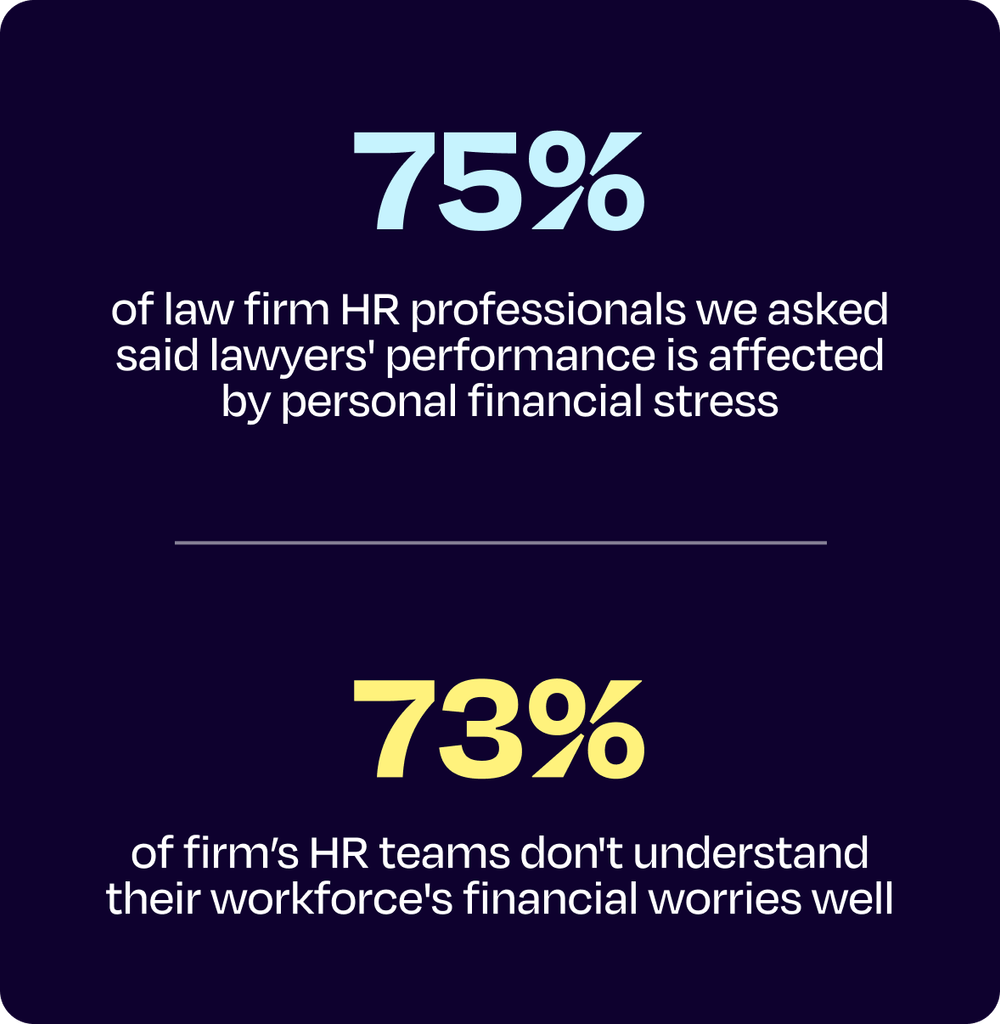
Our survey told us it’s true your business staff might be dealing with more money worries than your lawyers. We found that 86% bring money worries to work sometimes, often or very often. What is more surprising is that your lawyers are not far behind.
It might be unexpected given how comparatively well paid solicitors tend to be, but three quarters of HR and reward leaders we asked said that their lawyers bring the personal financial pressures they are dealing with into work sometimes, often or very often.
The numbers also show that the problem is greatly under-recognised. 73% of legal HR and reward professionals we asked told us they don’t understand their workforce’s financial worries well.
Effectively supporting your employees’ financial wellbeing involves recognising and understanding the money-related pressure points and challenges they face throughout their careers. Because that understanding is lacking, currently financial wellbeing support often takes the form of static resources which might always be available but are not flagged to the right people at the right time (and are therefore underused). Or firms offer sporadic webinars which are equally broad and untargeted.
The situation is compounded by a legal industry stigma problem: 29% of our respondents believe law firm culture actively discourages people from taking up financial wellbeing support when it is available to them. Yet 76% said law firms’ financial wellbeing needs are “about the same as any other industry”.
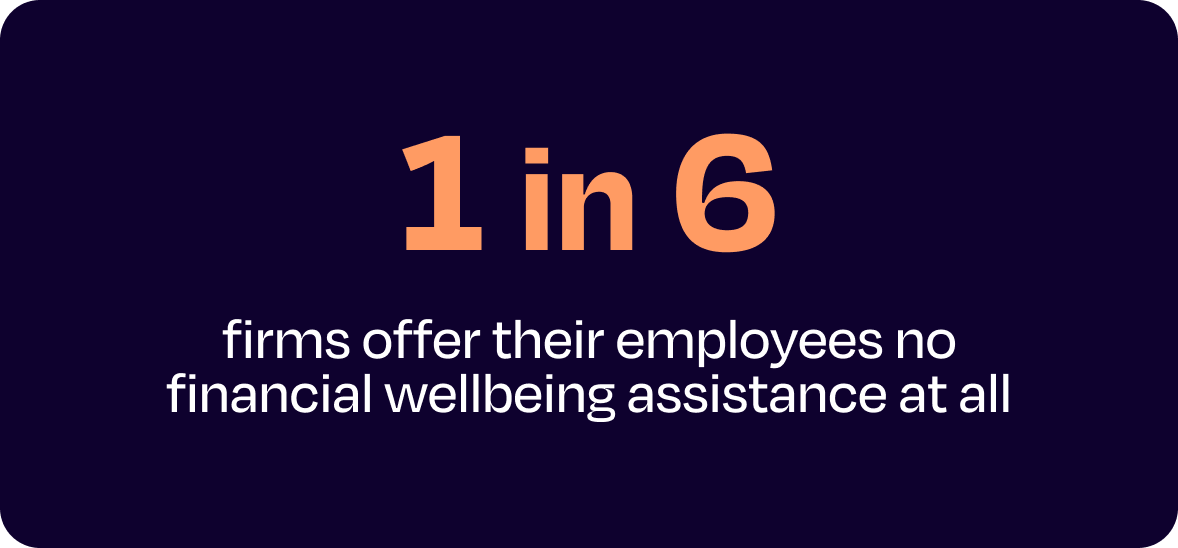
Often there is no support available at all. 16% of the firms we asked said they didn’t offer financial wellbeing support of any kind.
Good support that employees actually engage with intervenes when the time is right, and cuts off the big financial pressure points before they happen. Whether it’s tackling retirement, what to do when you’re handed a big salary rise, planning for a family, dealing with the £100k tax trap or managing childcare, a programme based on holding well-informed conversations about money at key life and career stages is of huge value.
In the rest of this report we will look at:
- The main financial pressure points for lawyers and law firm employees throughout their careers.
- How much support your people need at each stage vs how much is currently provided.
- The practical ways you can help your workforce stay in control and focus on their work.
3. Key career stage support: what firms offer vs what they need
Looking at six key life and career stages and the financial challenges they pose, we asked respondents to rate what they think the level of need for financial wellbeing support is on a 0-4 point scale. We also asked them to rate the level of support they currently offer, and examined how the two measures compared.
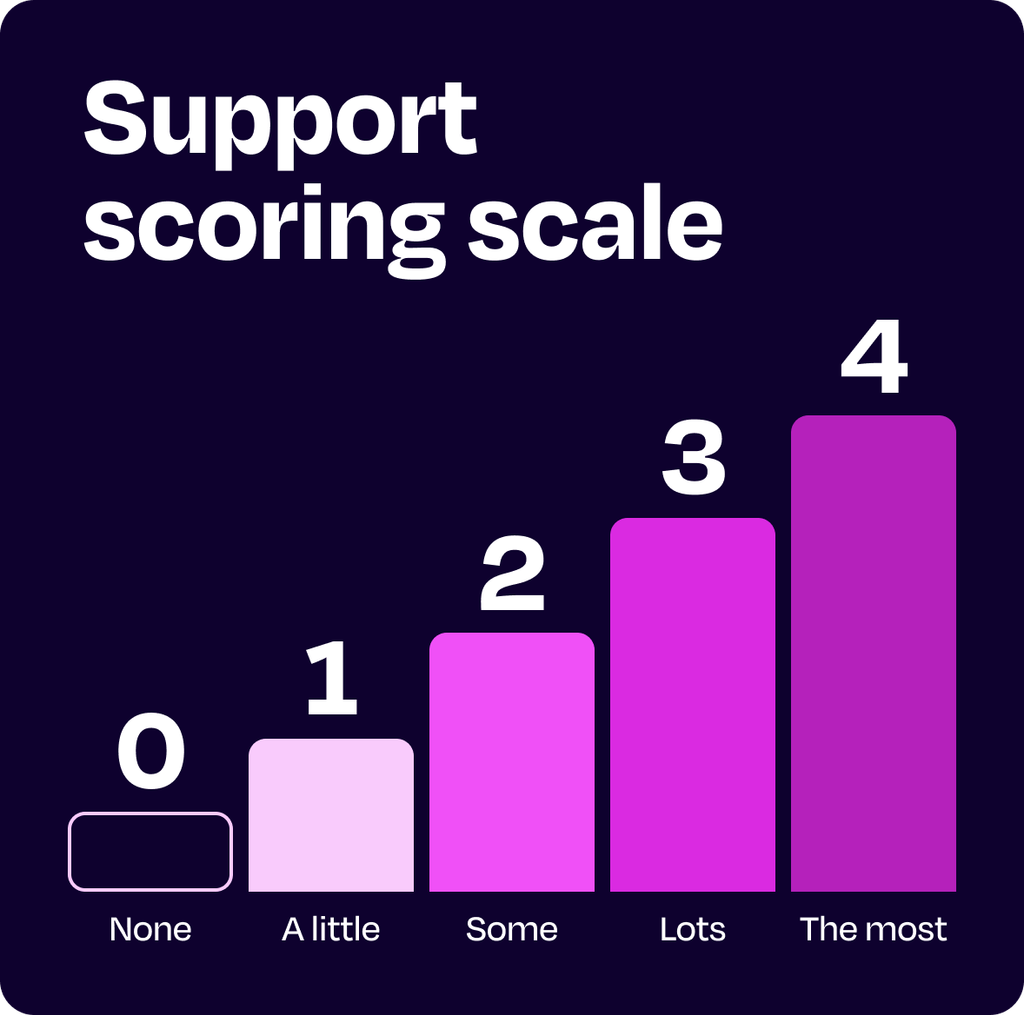
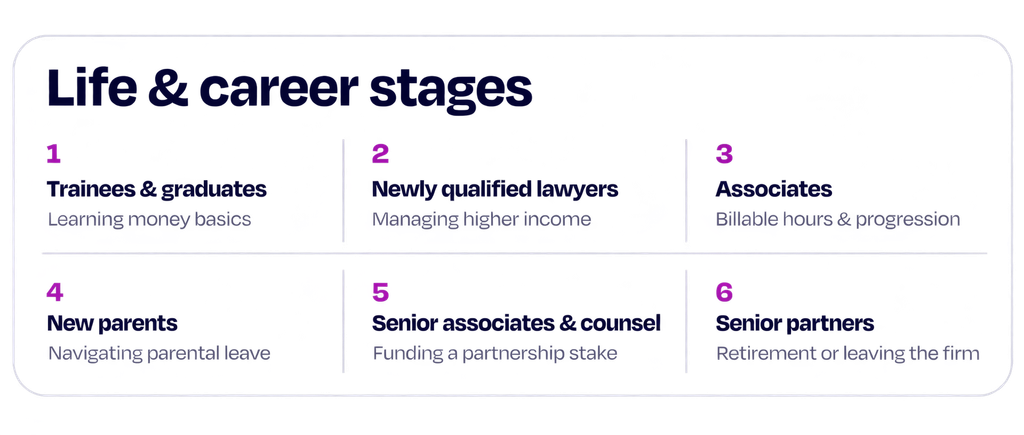
Across all six stages, the conclusion is clear. The average level of support employees are judged to need is nearly double the level firms currently provide (average score 2.6, vs 1.5). In plain terms, HR leaders put average need for support between “Some” and “Lots,” but said what they actually provide is between “A little” and “Some.”
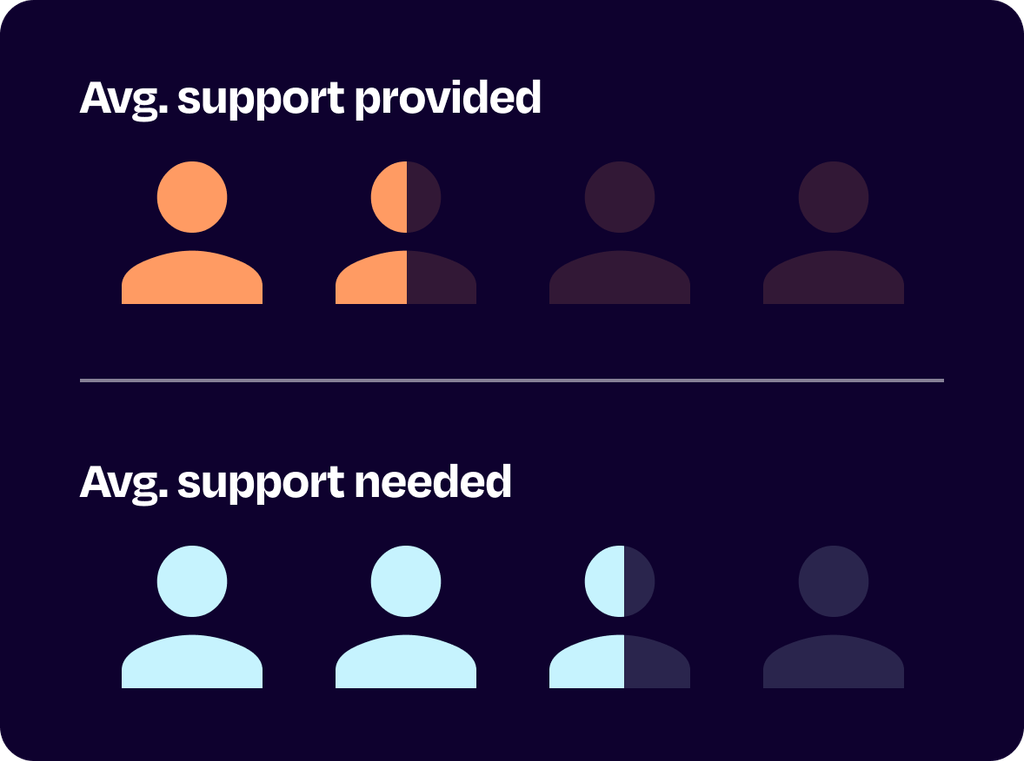
The below table shows the support gap for each stage, from largest to smallest.
| Life stage | Support needed average score (0-4) | Support provided average score (0-4) | Gap (% of maximum score) |
| Newly qualified lawyers: increased income | 2.6 | 1.3 | 32.0% |
| Parents: parental leave, work/life balance | 2.6 | 1.4 | 30.8% |
| Trainees: basic financial management | 2.7 | 1.5 | 28.0% |
| Planning for retirement | 3.0 | 2.0 | 25.5% |
| Senior associates/counsel: funding partnership | 2.3 | 1.5 | 20.0% |
| Associates: billable-hours and progression stress | 2.1 | 1.4 | 18.0% |
| All life stages average | 2.6 | 1.5 | 25.7% |
The Associate stage
The stage with the smallest support gap (associates managing billable-hours and progression stress) is in that position only because it has the lowest perception of need (52.8%), not because effective support is in place. This suggests law firms see day-to-day billable hours pressure as the least significant of the six stages we asked about, even though it’s arguably the most distinctively “law firm” feature of daily working life.
In the following sections of the report we will look in depth at the life stages where the gap is greatest.
4. Early careers: supporting trainees and newly qualified lawyers
Our survey rates early career support at a huge 32% lower than is needed. The positive story is that the need for support at this stage is recognised. It’s just that what most firms provide lags a long way behind.
Trainee lawyers and the cost of living
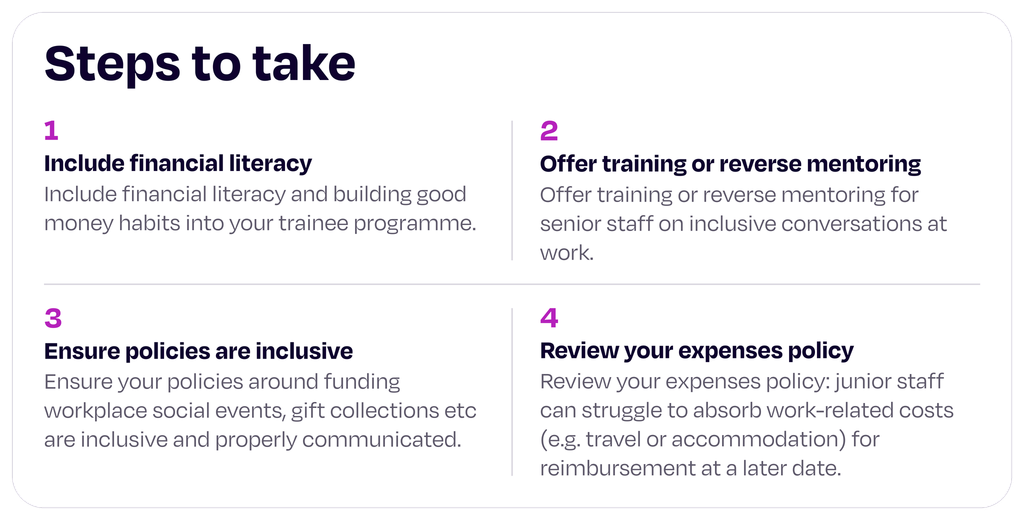
As a trainee lawyer (or a graduate in your other business functions), salaries are comparatively low and junior professionals face cost of living challenges that are not usually associated with the legal profession. Trainees are working alongside high-earning lawyers further on in their careers, so while they’re learning to manage their finances they are also navigating potentially expensive social situations (team lunches, drinks, gift collections etc) and conversations (about holidays, clothes, houses) made difficult by income differences.
Trainees from non-traditional legal backgrounds can struggle the most with these situations, given the lack of an advice or informal mentoring network. It’s important to remember that supporting your junior talent with financial wellbeing is a crucial step towards your inclusion and social mobility goals.
The NQ salary jump
When a trainee lawyer qualifies, they experience the single biggest salary increase they’re ever likely to have. And it comes right at the beginning of their careers when their financial awareness is not always fully mature. Newly qualified solicitors at magic circle firms now start on salaries of around £150,000, and some US firms offer their NQs even more. Even at medium, boutique and regional firms, the jump from trainee to NQ pay is enormous in percentage terms. A sudden, large increase in take-home pay, without financial education to go with it, should be a red flag for potential to negatively impact wellbeing and performance at work. As well as learning responsible spending and looking into investment for the first time, your NQ lawyers might well also be falling into the £100k tax trap at an age where they have no visibility or understanding of what that is.
“Trainees and newly qualifieds are an area we haven’t targeted specifically. Getting a training contract is huge, but trainee salaries are quite low compared to NQ, where there’s a massive jump. Trainees moving to London face high renting costs. That’s a tricky time.”
HR Director, boutique law firm
Our survey data shows the support gap is sharpest at exactly this point. Newly qualified lawyer support is the lowest of all six life stages we measured (average score 1.3 out of 4), while need is rated among the highest (2.6 out of 4). Of the respondents who rated the NQ support need as “Lots,” 62% said current support was only “none” or “a little.” Trainee need is rated just as high (2.7), though support here is rated slightly better (1.5).
5. Partnership, parenthood and the mid-career talent drain
Funding partnership
Partnership is a five- or six-figure financial commitment, unique to the legal profession. Funding a capital contribution is unlike any financial decision employees in other industries ever face. The associated financial stress is increased by the fact that the offer typically arrives at the “sandwich generation” life stage where pressure from mortgages, supporting young families and caring for aging parents is at its peak.
“We’ve got lots for trainees and the newly qualified, and also for retirement. What’s missing is the gap for people who’ve recently transitioned into partnership.”
REWARD LEADER, international law firm
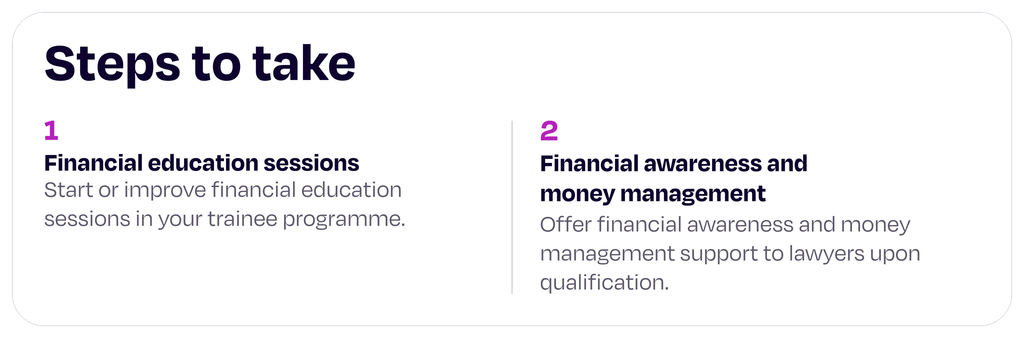
The case for financial wellbeing support at this stage should be obvious, given the billing and reputational implications of a new partner’s performance at work being negatively affected. And yet need vs support ratings for “senior associates and counsel funding a partnership stake” show 62% of those with “Lots” of need report no or only a little support for what is one of the most significant financial decisions of a lawyer’s life.
Parenthood
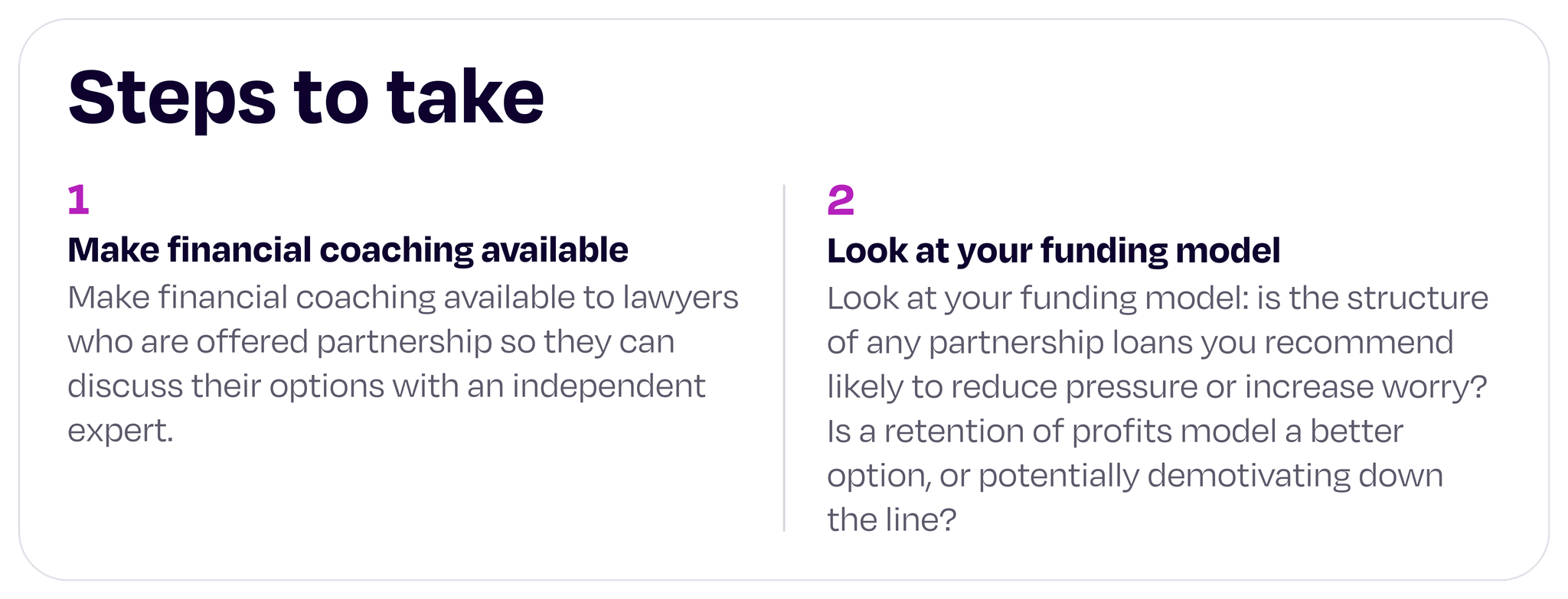
Both HR leaders we spoke to in depth about financial wellbeing issues raised parenthood unprompted. New parents show the joint-highest need score of any life stage (2.7) and the second-lowest support score (1.4), giving the second-largest gap overall (30.8%). Of the respondents rating need as “Lots”, 57% say current support is “none” or “a little.” Most strikingly, among the 5 respondents who rated need at the very top level (“Most”), not one reported support above “some.”
“For senior associates, many have just come back from maternity leave and are juggling their job with private nursery costs. From a wellbeing and flexible working perspective we’re a 10 out of 10, but paying for childcare is a real challenge.”
HR Director, boutique law firm
The impact of childcare responsibilities falls disproportionately on women, making this aspect of financial wellbeing an important equality issue for your firm. The Law Society’s 2023 Annual Statistics Report shows women make up 51% of solicitors in private practice, yet only 34% of partners or partner-equivalents. Female solicitors have a 13% chance of reaching partner level, versus 28% for men: less than half.
“It’s not uncommon across the legal industry, and professional services as a whole, that the level of commitment needed to fulfill your duties while raising a family is really difficult. We’re addressing it through education: talking to women about the gender pensions gap, and what actually happens to their pension when they’re on maternity or unpaid leave.”
REWARD LEADER, international law firm
This often leads to women leaving the profession or moving in-house for a legal role that offers greater flexibility and a more manageable workload. For smaller firms willing to offer similar flexibility, it’s an opportunity to recruit highly talented mid-career lawyers whose salary requirements would otherwise be too high.
“We can’t compete with US law firms on salary, but we can offer a better work-life balance”
HR Director, boutique law firm
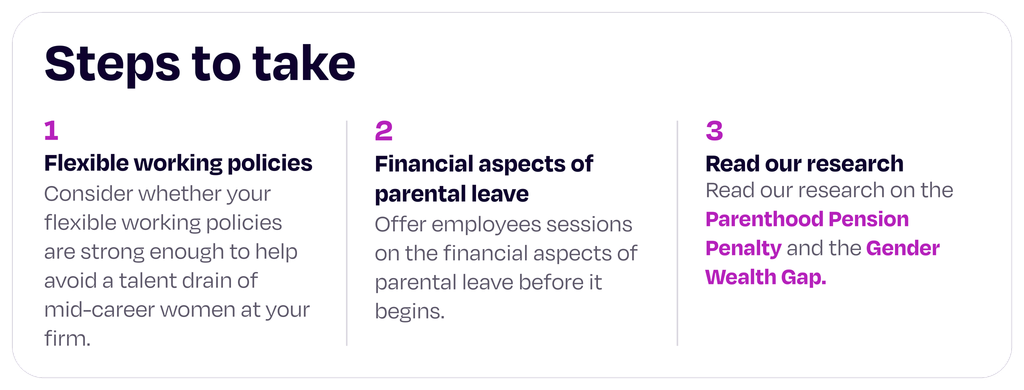
*Read about The Parenthood Pension Penalty here and The Gender Wealth Gap here
6. Supporting retirement and smoothing out senior talent progression
Retirement planning is one of the most financially complicated things people will ever do. For decades your people have been building their finances, and now they need to maximise what they have to last them the rest of their life. That means a lot of decisions: how and when to draw an income, which accounts to draw from first, whether to take a tax-free lump sum, and how to manage tax as you go. Some of those decisions can’t be undone.
So it isn’t surprising that retirement planning is considered to be the most important life stage in terms of need for support, with our survey showing an average score of 3 on the 0-4 scale. It also has the largest group of respondents (13 of 44, around 30%) rating it as having greater need than any other stage. While it’s the best-supported stage overall (scored as a 2 on average), support is still significantly under-resourced compared to need.
External data helps explain why there’s still a gap even at the best-supported life stage. While 89% of eligible UK employees are saving into a workplace pension (according to a DWP Workplace Trends report), 51% of employers offer no retirement support beyond that (according to Punter Southall Aspire research cited in The HR Director). A pension is not the same as a plan, and not having a plan has consequences that go well beyond the individual nearing retirement.
Clearer planning before retirement can make a real difference to what your people actually end up with each year. Often, the size of the pot matters less than how well the income from it is managed once it’s being relied upon.
Leaving this transition unsupported can increase financial stress among your most senior professionals who can least afford the distraction. Even though it’s safe to assume your senior lawyers know that they can afford to retire, planning their financial arrangements well ahead of time reduces their stress and allows them to continue to focus on their job and passing on their knowledge within the firm effectively.
Lack of planning doesn’t just affect the individual. It keeps senior lawyers in post past the point where they’d otherwise be ready to wind down, blocking the progression path for talented lawyers who are ready to move up and waiting for a senior role to open.
“I’ve put a proposal in for support for partners up to five years from retirement, including financial planning and second careers. Where partners used to retire at 65 under their contracts, we’re now keeping them on in non-partner consultant roles, giving them headspace and time to plan financially.”
HR Director, boutique law firm
There are some effective ways firms can manage this. For instance, senior partners who are ready for the next stage are increasingly transitioning into consultant roles or formal alumni networks, rather than making a binary choice between continuing as they are or fully retiring. This gives the individual the financial planning runway they need, gives the firm continued access to their expertise and client relationships, and frees up the progression path for the senior associates coming up behind them.

7. What the support gap really means for law firms
The productivity cost is difficult to quantify, but some broad assumptions can be made. Using the Guideline Hourly Rates published by HMCTS (a blended rate of roughly £225/hour for a typical boutique or medium firm fee-earner outside London) alongside Salary Finance’s finding that employees with money worries lose an additional 1.7 hours per week of productive time compared to those without, and applying our survey’s 73% figure for affected legal practitioners, the table shows what the worst case scenario could be.
| Firm size | Fee earners | 73% affected | Estimated annual billable hours cost |
| Boutique | 20 | 15 | ≈£263,000 |
| Medium | 100 | 73 | ≈£1.28 million |
The numbers are stark, and provide a clear RoI on the cost of the support you need to offer to tackle the problem.
8. Six practical ways to close the gap
- Build financial education into trainee induction, and carry it through to NQ:
You probably already run a structured induction programme, so financial education can be added rather than requiring a new delivery channel to be built. - Design support around life-stages:
Qualification dates, parental leave start dates and retirement pathways are known in advance. Support timed to arrive at those moments will reach people when they need it, rather than sitting unused as a generic benefit. - Treat the parenthood and partnership stages as a related retention risk:
These under-supported life stages are often happening around the same time to the same people, but the work/life balance needs of parenthood is disproportionately excluding women from partnership. Addressing the two as related issues will help retain mid-career talent. - Treat retirement support as more than pension optimisation:
Offering clear transition options and financial planning support is a comparatively low-cost way to keep senior lawyers on the retirement pathway focused on the firm, while also freeing up the progression path for talent in the layer below. - Address barriers to access:
With 29% of our respondents believing law firm culture discourages people from seeking support, messaging that normalises support and comes from senior professionals who have taken up support themselves will increase your uptake. And forming your financial wellbeing offering around life stages gives your people a clear idea of how they will benefit through their careers, again raising levels of engagement.
“The premise is to meet people where they are, at every stage of their life. You can lead a horse to water, but you can’t force it to drink: if you just give people a website full of resources, that’s just another point of information. People engage a lot more when something is dropped directly into their calendar and feels personalised to them.”
REWARD LEADER, international law firm
- Understand the picture:
With 73% of HR and reward professionals saying they don’t understand their workforce’s financial worries well, a good financial wellbeing platform will come with usage and engagement data that gives you the insight you need to get closer to your workforce and target support where it’s needed.
For smaller firms especially, scarce HR time and resource is a practical constraint that makes closing the gap harder. Building and maintaining a tailored life-stage-aware financial wellbeing programme on your own is often not realistic. That’s where bringing in an expert financial wellbeing benefit provider to help you support your entire workforce is a valuable option.
“In terms of HR, it’s just me. I do the full employee cycle, from strategy right through to onboarding. It’s a big role, and a very under-resourced function generally.”
HR Director, boutique law firm
9. Conclusion
The data in this report tells a consistent story: the need for financial wellbeing help outstrips support at every stage, and firms are not clear where the gap lies. The cost of the gap is measured in lost billable time and a broken progression pipeline that loses or demotivates talented people at a key stage (whether it be starting out, a pay jump, parental leave, care costs, a partnership buy-in or a retirement transition).
Octopus Money already works with a wide range of UK law firms including Browne Jacobson and Osborne Clarke to deliver a full programme of financial wellbeing support to all of their employees regardless of role, life stage or earnings. If you would like help understanding where your firm’s gaps might be, we would be happy to discuss our findings with you and talk through how we can help.
Contact us to talk about your firm’s financial wellbeing programme
Survey methodology
The report is based on a September 2026 Octopus Money survey of 45 UK law firm HR and reward professionals (carried out in partnership with People in Law), interviews with two HR leaders at UK law firms, and external research statistics.